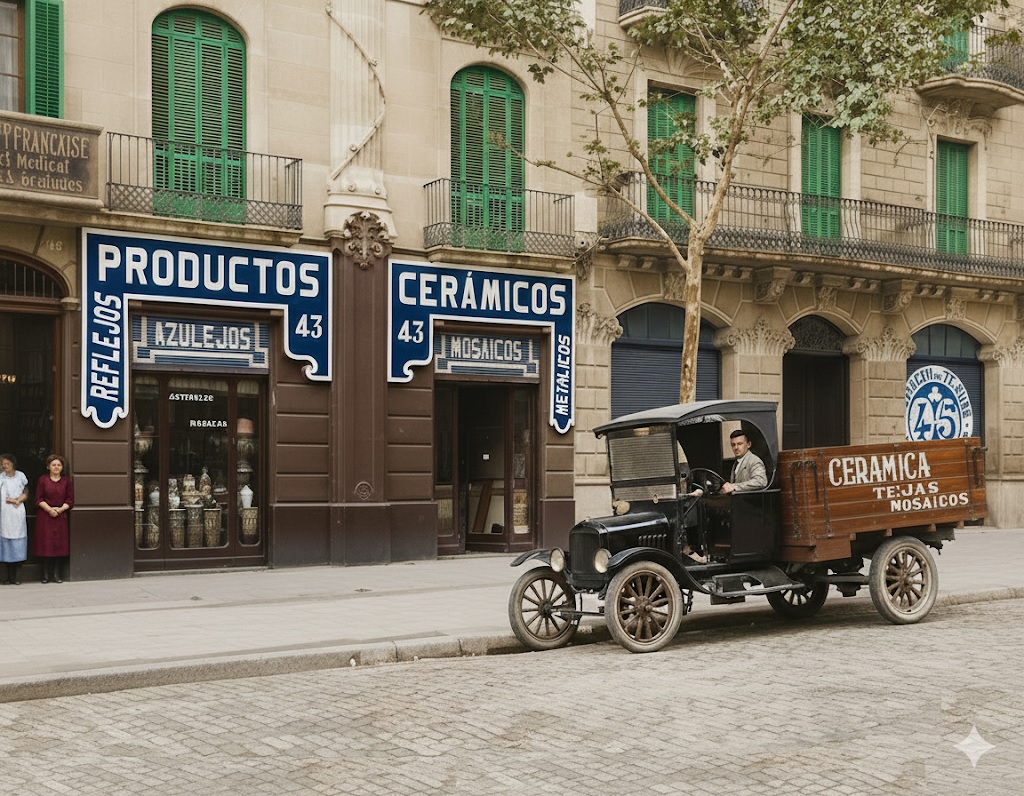
The history of Ceràmiques Coral Barcelona is the chronicle of a family saga that has helped beautify Barcelona since the late 19th century.
Our Generational Journey
Foundation and Modernist Splendor
In March 1890, Josep Coral Guasch founded Productes Ceràmics Josep Coral. Initially located in a small shop at 21 Aribau Street, it focused on distributing construction and decoration materials. In its early years, it became the primary link between legendary factories such as La Cartuja de Sevilla (Pickman) and the growing Catalan bourgeoisie.
In 1910, business growth forced a relocation to Ronda de Sant Antoni, 43, adopting the commercial name Productos Cerámicos José Coral (mandatory translation into Spanish during that period).
Consolidation and Modernity
Under the direction of his son, José Coral Casant, the firm modernized its logistics by using Ford Model TT trucks (as seen in the 1923 image). This distribution capacity was essential to supply projects for the 1929 International Exhibition and the iconic hydraulic tiles and Nolla mosaics of the Eixample. In 1931, the commercial name was translated back into Catalan as Productes Ceràmics Casa Coral.
Market Diversification
In 1975, under the direction of Montserrat Coral Rovira, the company was renamed Cerámicas Coral. A broader range of products was incorporated: sanitaryware, faucets, shower screens, and bathroom furniture, adapting to the aesthetic demands of the time.
A Living Legacy in the 21st Century
In late 2014, Oscar Vidal Coral took over management, updating the name to Ceràmiques Coral Barcelona. Today, the company balances respect for traditional ceramics and hydraulic mosaic with new trends and technological innovation, such as digital printing.
Specialization and Commitment
Our main objective is to offer high-quality, domestically manufactured products that comply with EC directives. Our specialization covers:
- Artisanal Ceramics: Reproduction of tiles and hydraulic mosaic floors for the restoration of iconic buildings.
- Variety of Styles: Antique, rustic, enameled ceramics, glazed tiles, hand-painted pieces, and terracotta.
- Custom Projects: Solutions to transform any space, ranging from modern to rustic or classic styles. Reproduction of models and colors for landmark buildings.
- Other Projects: Supply for set dressing in stage construction and set design for audiovisual productions, films, and advertising spots.
Historical Curio: The Name of Gran Via
- The name of Barcelona's Gran Via has reflected the city's history:
- ● With the city's growth under the Cerdà Plan, streets lacked names and had codes instead.
- ● At its inception (1859 - 1863), it was simply known as Letter N (or Number 11).
- ● Upon urbanization on September 27, 1863, it was renamed Calle de las Cortes (official Spanish name) at the proposal of Víctor Balaguer.
- ● 1931: With the advent of the Second Republic, it was officially Catalanized to Avinguda de les Corts Catalanes.
- ● March 7, 1939: Following the Civil War, it was renamed Avenida de José Antonio Primo de Rivera for 40 years.
- ● June 22, 1979: With the return of democracy, the original Catalan name was restored, adding "Gran Via" as it was popularly called: Gran Via de les Corts Catalanes.
Historical Curio: Evolution of the Commercial Name
- The firm's commercial name has been a faithful reflection of the city's history, adapting to the political twists of each era. Due to varying social circumstances, the official denomination oscillated between Catalan and Spanish at various moments, thus bearing witness to the evolution of our identity over more than a century:
- ● 1890: Productes ceràmics Josep Coral.
- ● 1910: Productos Cerámicos Jose Coral (mandatory translation into Spanish).
- ● 1930: Productes ceràmics Casa Coral (return to Catalan).
- ● 1930: Productos Cerámicos Casa Coral (mandatory translation into Spanish).
- ● 1931: Productes Ceràmics Casa Coral (return to Catalan).
- ● 1939: Casa Coral (simplification to avoid language bans under the dictatorship).
- ● 1980: Cerámicas Coral (popular name of the time).
- ● 2014: Ceràmiques Coral Barcelona (current name).
Visit Us or Explore Our Catalogs
We invite you to visit us or explore our wide range of catalogs featuring high-quality products.